Lightning Rambles
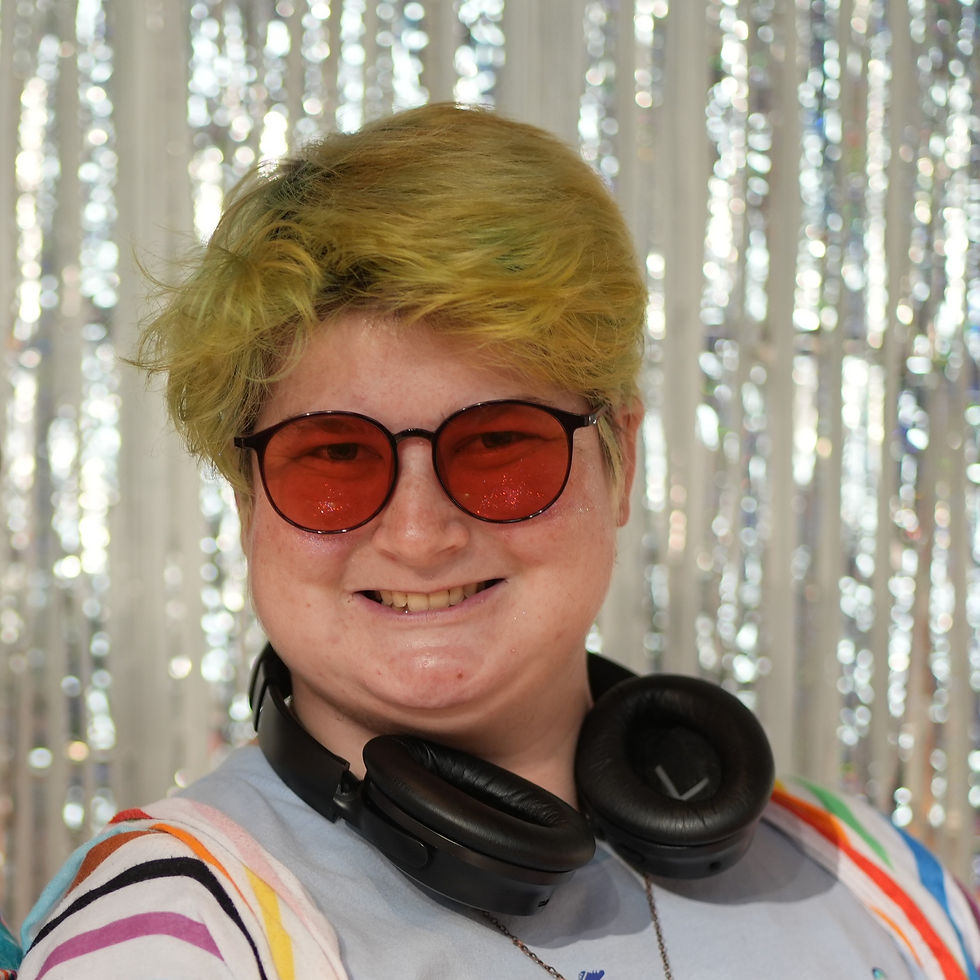
Remiel Cooper:
Autistic, Multidisabled, Part Time
AAC User
ID: Remiel Cooper- a fat white person smiles at the camera. Remiel has short green hair that has faded past its prime. They wear red tinted sunglasses with black rims that make it hard to tell the color of their eyes. beneath their sunglasses you can see glitter glowing on their cheeks. Around their neck their is a pair of black noise cancelling headphones. END ID.
About Remiel Cooper
Remiel Cooper (they/any neopronouns) is a new masters student at San Francisco State University in the field of Speech Language Pathology. They are a multidisabled Autistic part time AAC user. They are passionate about work in the AAC field- especially around the topic of self advocacy oppurtunities for AAC users. For their AAC app, Remy uses TD Snap and has completely customized TD Snap’s Core pageset, creating what they refer to as their ‘Lightning’ pageset as a new standard for what robust AAC should look like. They enjoy writing and educating about their experiences being disabled.
They are a member of SFSU’s DREAM (Disability. Rights, Education, Activism, Mentoring) club and Student Union, focused on equity on campus. They are a participant in their chapter's NSSLHA (National Student Speech Language Hearing Association).
Much of their time can be found spending their time with their two cats and service dog in training (Hestia, Persephone and Thunder respectively), playing Minecraft, and regaining energy from the daily drain of living as a disabled individual. Their favorite color is green.
They believe that we can eventually create a world where disabled people of all races, genders, sexualities, immigration statuses, sizes, abilities and more can be radically accepted, supported, and accommodated.
They have been assigned Tang as their ‘Lego Monkey Kid’ equivalent by their friends.
Talks, Teachings, and Trainings
ASHA
CSHA
AAC users have demands placed on us every day. These demands are intense and they don’t stop. When our device is in front of us, these demands should stop. Unfortunately, for most AAC users, these demands only increase. We’re told how to talk, when to talk, and who to talk to. Even if we’re given the freedom to explore on our own device, we’re rarely given the chance to edit it and make it our own. This talk aims to discuss how we can reduce cognitive load for AAC users- by an AAC user. Explore ways to support speech in AAC users of all ages- not just children- and give autonomy to users and their devices. Let’s lighten that load.
Speech-language pathologists (SLPs) are taught anti-ableist approaches for working with clients. But what about colleagues? What happens when ableism comes from within your own field? Remiel Cooper shares their journey as an SLP-hopeful who is a part time AAC user. Using AAC and being multidisabled, they have had to navigate obstacles that very few- if any- SLP students have had before. They’ll share the importance of access, the reality of barriers, and their personal motivations for continuing forward. From a childhood strife with stigmatizing labels, to a university experience that sometimes seems to doubt their ability to succeed, they’ll give a wide overview of how the field is responding to diverse populations- both as a fellow practitioner and a client.
Other
AAC users are an incredibly vulnerable population that has historically been taken advantage of again and again, often due to the communication barriers AAC users face. Self advocacy guarantees access to safety, freedom, and self-determination- which are essential for AAC users. What could a world look like where every AAC user had access to the communication bill of rights on their very device? This presentation evaluates the self advocacy opportunities provided to AAC users as a result of per-user individualized devices and systems paired with user collaboration. This is presented by a part time AAC user who draws from their own experiences with AAC and reflects on how they have grown in their own self-advocacy skills.
Discussion of generative AI (Gen AI) usage has increased in AAC spheres, but it's rarely comprehensive or objective. Historically, Gen AI presentations at ASHA and other conventions have been biased towards its usage featuring people who generally benefit from the inclusion of Gen AI in systems- including AI experts and AI AAC collaborators. A primary voice missing in this conversation is AAC users. This presentation, presented by a part time AAC user who is a graduate SLP student, provides a comprehensive review of Gen AI in AAC systems, discussing pros, cons, and possible paths forward. They will critically look at the history of Gen AI, as well as how it has been implemented in AAC, inviting the audience to have a more nuanced look at AI and encourage them to critically consider the implications of GenAI usage in practice.
A lecture focusing on Neurodiversity and Autism. The coining of the term 'neurodiversity' by Judy Singer is discussed, followed by the neurodiversity spectrum. The presentation discusses biological vs social views of neurodiversity and interpreting behavior. Autism is then looked at. The history of autism is discussed, including functioning labels and movements from awareness to acceptance and pride. Interventions and intersections are also discussed. Finally, there is an application activity.
To request a copy of this presentation in full or to request Remiel present it, please contact us.
In this presentation I share my personal story I share my childhood where I went undiagnosed and faced child abuse to my teen years when I was institutionalized . I then discuss my early adult years, finding AAC, and entering university. I then discuss joining the speech therapy program at my university and entering the master's program while facing access issues due to being disabled.
To request a copy of this presentation in full or have Remiel present it, please contact us.
This lecture gives an overview on what AAC is, who uses it, types of AAC, as well as some additional important information, all from the prospective of an AAC user.
To request a copy of this presentation in full or have Remiel present it, please contact us.
This presentation discuss what it means to be an AAC user what becoming an AAC user looks like, as well as many AAC user resources. In additions it discusses AAC etiquette and focuses on AAC user freedom of speech. It talks about AAC user culture and how to best interact with us.
To request a copy of this presentation in full or have Remiel present it, please contact us.
This lecture goes over Remiel Cooper's experience with TD Snap and how they learned to start customizing pagesets. Much of this discussion leads to what gave them the inspiration and drive to start making the Lightning Core.
To request a copy of this presentation in full or have Remiel present it, please contact us.

Language Use
Remiel Cooper primarily uses identity first language to refer to their experiences with disability. They expect people with this knowledge and the mental capacity to understand this preference to use this language for them. Some examples include:
Remiel Cooper is Autistic (capitalized) NOT a person with autism.
Remiel Cooper is a multidisabled person NOT a person with disabilities.
Remiel Cooper is a part time AAC user NOT a person who uses AAC part time.
Their use of identity first language is rooted in their connection to their disabled community and identity- something they cannot be seperated from.
Exceptions are allowed when that is the general community’s preference. Some examples include:
Remiel has a Traumatic Brain Injury. Remiel has ADHD.